Showing posts with label games. Show all posts

LS30 Wireless Gaming Headset

This LucidSound LS30 Wireless Gaming Headset is a stylish and sophisticated choice.
Not only does the wireless LS30 headset look great, but it also offers outstanding functionality different to any other gaming headphones on the market.

Boasting complete versatility and cross-platform compatibility, the LucidSound LS30 works seamlessly with the Xbox One and PS4, as well as legacy consoles including the Xbox 360 and PS3.

Equipped with intuitive controls and a revolutionary design, this gaming headset comes with an integrated microphone and a removable boom microphone, so that it can be used on the go with mobile gaming devices, phones and audio devices.

Useful info:

  • Cross-platform compatibility
  • Compatible with legacy consoles
  • Intuitive, easy-to-use controls
  • Integrated microphone
  • Removable boom mic
  • Suitable for mobile and audio devices
  • LucidSound LS30 Wireless Gaming Headset

  • Depth: 90 MM
  • Height: 190 MM
  • Width: 185 MM
  • Gaming Accessory Type: Headsets
  • http://www.very.co.uk

Playstation 4 Silver DualShock Controller

MPN: 9895657 EAN: 711719822943
The DUALSHOCK®4 wireless controller defines the new generation of play, combining revolutionary features with an intuitive design and precise controls. The new models feature a stylish matt finish, show your light bar from above and allow you to control your PS4™ via USB cable as well as through Bluetooth®. Ergonomic Design Get to grips with an elegant, super comfortable design, while highly responsive analog sticks and buttons mean greater precision during gameplay. SHARE Button Use the SHARE button to upload your gameplay videos and pictures on social networks. Stream live gameplay to Twitch, YouTube and Dailymotion or edit your recorded gameplay videos and share them on Facebook and Twitter. You can also invite online friends to play your games with you, even if they don’t own them with Share Play*2. Touch Pad Guide, gesture and draw with the responsive touch pad – now restyled so you can see your light bar colour from above as you play. Light Bar The integrated light bar provides gamers with visual information at a glance, such as which character they control or health status, for more intuitive gameplay. It also helps the PlayStation®Camera track your controller position – allowing you to interact with your virtual surroundings while using PlayStation®VR. Built-in Speaker and Stereo Headset Jack Enjoy extra sound effects – straight from the controller – and chat with online friends via a headset, such as the stereo headset included with the PS4™ system. Vibration Feedback Feel even more deeply engaged with the action as the controller shudders and shakes in your hands, thanks to intuitive vibration motors.

PS4 Pro

Trois ans à peine après le lancement de sa PlayStation 4, Sony revient avec une nouvelle console de même génération, plus puissante et taillée pour la 4K, qui cohabite avec son aînée. Une première dans l’histoire des consoles, mais laquelle choisir ?

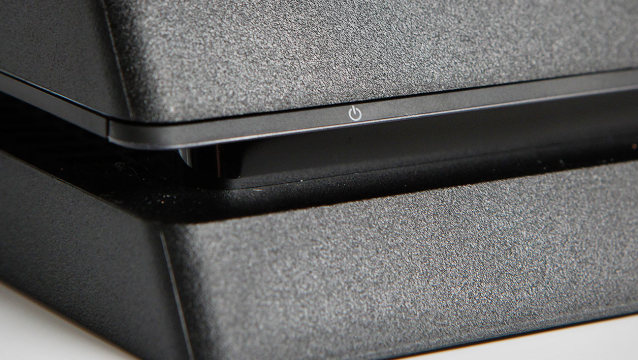
Une forêt-noire. La PlayStation 4 Pro ressemble à une pâtisserie à étages. Et oui, elle fait saliver. Ce design en empilement est la première chose que l'on constate quand on la sort de sa boîte. On note ensuite que, dans la lignée de la PS4 Slim, lancée en 2016, Sony a abandonné le revêtement brillant qui prenait tant les rayures et les traces de doigts.

Trois couches et quelques changements

On trouve désormais une surface mate découpée en trois couches distinctes. Chacune est séparée des autres par une strate brillante, placée en retrait. C’est dans ces intercalaires qu’on trouve, en haut, le lecteur de Blu-ray en mange-disque, et dans celui du bas, les deux ports USB (3.0) de façade. Deux étages, deux boutons et trois remarques.
La première, c'est une mauvaise nouvelle. Arrêtons-nous quelques secondes sur le lecteur Blu-ray. Contre toute logique, il n’est toujours pas capable de lire des Blu-ray 4K HDR. Bizarre pour une console qui est là pour pousser l’Ultra HD dans nos maisons, à l’heure où les téléviseurs 4K deviennent « enfin » plus abordables. Bizarre également quand on sait que Sony est un des grands défenseurs de ce format. Le géant japonais a, semble-t-il, décidé de pousser la 4K/HDR en streaming sur la PS4 Pro. Bon courage si votre bande passante est un peu faiblarde…
Deuxième remarque : bonne nouvelle, Sony a compris que, dans l’obscurité de votre salon aux heures où tout le monde dort sauf le joueur acharné, il était très difficile de distinguer le bouton pour allumer sa console et le bouton d’éjection du disque. Ces derniers sont désormais mécaniques et prennent la forme d’une fine bande placée à gauche des ports USB. Et il faudra vraiment être maladroit pour confondre l’un et l’autre.
Enfin, bonne nouvelle encore, on trouve à l’arrière de la bête un troisième port USB qui permet de recharger une troisième manette, ou de brancher le PlayStation VR sans avoir un fil qui pendouille à l’avant. Pour le reste de la connectique, pas de changement notable. Le port Auxiliaire pour la Playstation Camera est identique. En revanche, la prise du câble d’alimentation est différente. Elle est désormais plus encombrante, aux dimensions de celles qui intègrent une terre. En l’occurrence, Sony n’a pas ajouté cette petite sécurité qui aurait pu davantage protéger la configuration un peu plus gourmande qui trône à l’intérieur. Le câble est lui plus costaud pour assurer l'approvisionnement en électricité de la bête.

Du bruit et de la fureur électrique


Car la PlayStation 4 Pro consomme logiquement plus que son aînée, puisqu’on lui en demande plus. Là où la PS4 consommait 110 W en affichant un jeu en Full HD, la Pro monte à 155 W pour un jeu en 4K – son plafond maximal est fixé à 310 W. On notera d’ailleurs en passant que les différentes options d’affichage proposées dans les jeux optimisés pour la Pro, comme le dernier Tomb Raider, ont un réel impact sur le travail de la puce et donc sa consommation. Ainsi, les « graphismes améliorés » aboutissent à voir la consommation de la bête monter à 125 W, tandis que l’augmentation de la fluidité du jeu, via l’option de « fréquence d’images élevée », fait passer la consommation à 146 W.
Cette augmentation de la consommation électrique en fonction des efforts demandés à la configuration s’accompagne également d’une légère augmentation du bruit produit par les ventilateurs de la PS4 Pro. Cette dernière est d’ailleurs, selon nos mesures, un tout petit peu plus bruyante que la PS4 « classique ». Pas de quoi réveiller la maisonnée, cependant.
Pour ceux qui aiment savoir ce qui se cache sous le capot – vous pouvez lire nos explications techniques détaillées sur sa configuration - sachez que la PS4 Pro embarque un processeur 8 cœurs similaires à celui de la PS4, sauf qu’il est plus rapide – entre autres. La partie graphique est assurée par la nouvelle technologie Polaris d’AMD et développe 4,2 Teraflops de puissance de calcul. Pour vous donner une idée, c’est deux fois mieux que ce que proposait la PS4 originelle. On trouve également 8 Go de mémoire vive pour assurer un fonctionnement plus fluide à l’OS, à l’interface et, bien sûr, aux différents jeux.
On notera que, comme pour la PS4 Slim, Sony a intégré un module Wi-Fi 802.11ac (5 GHz), ce qui pourrait vous éviter de devoir tirer un câble Ethernet, si votre box ou routeur suit.
Passons rapidement sur le DualShock 4. Il est identique à celui introduit avec la PS4 Slim, avec ses boutons et gâchettes en gris et son fin bandeau lumineux en haut du pavé tactile pour savoir quelle couleur a été attribuée à la manette.
Enfin, comme pour le modèle haut de gamme de la PlayStation 4 mise à jour, le disque dur affiche 1 To de stockage. Vous allez pouvoir stocker des jeux, des vidéos et des séries (presque) sans compter.
A franchement parler, quand on regarde la fiche technique de la PS4 Pro et surtout sa promesse, l'impression point d’avoir à faire à un PC gamer milieu de gamme... Et il faut bien avouer qu’on trouve assez peu d’ordinateurs à 400 euros pour jouer en (presque) 4K. En cela, la PS4 Pro pourrait même mériter le titre improbable de « console pour gamer PC ».

Beau, fluide ou 4K ?

Ceci dit, que donnent ces Teraflops à la pelle, ces cœurs surpuissants et le reste ? On mettra de côté l’interface, strictement identique à celle de la PS4, pour se concentrer sur les jeux. On retient d'abord l’apparition d’une détection automatique de la taille d’écran et les options d’affichage telles que le HDR (automatique ou désactivé) ou la « résolution » (720p, 1080i, 1080p ou 2160p)
Pour l’instant, peu de titres ont été optimisés pour tirer parti de la PlayStation 4 Pro. Sony garantit qu’ils seront au nombre de 45 d’ici la fin d’année. Nous nous sommes concentrés sur l’un d’eux, les dernières aventures de Lara Croft, Rise of the Tomb Raider, sorti le 11 octobre dernier sur la console de Sony après une longue période d’exclusivité sur Xbox One.
Que signifie l’optimisation d’un jeu pour la PS4 Pro ? Tout dépend des titres, des studios... Sony veille à leur laisser plusieurs voies techniques et possibilités. Par exemple, pour The Last of Us : Remastered, il s’agit d'ajouter le rendu HDR, qui donne plus de profondeur aux environnements, et de coller aux 60 images par seconde. Pour Tomb Raider, la donne est un peu différente.
Crystal Dynamics a décidé d’offrir le choix entre trois options. Plus de fluidité, des graphismes améliorés ou un rendu 4K. Dans les faits, les trois sont pertinents et on apprécie de pouvoir changer les réglages à volonté
Pour l’instant, peu de titres ont été optimisés pour tirer parti de la PlayStation 4 Pro. Sony garantit qu’ils seront au nombre de 45 d’ici la fin d’année. Nous nous sommes concentrés sur l’un d’eux, les dernières aventures de Lara Croft, Rise of the Tomb Raider, sorti le 11 octobre dernier sur la console de Sony après une longue période d’exclusivité sur Xbox One.
Que signifie l’optimisation d’un jeu pour la PS4 Pro ? Tout dépend des titres, des studios... Sony veille à leur laisser plusieurs voies techniques et possibilités. Par exemple, pour The Last of Us : Remastered, il s’agit d'ajouter le rendu HDR, qui donne plus de profondeur aux environnements, et de coller aux 60 images par seconde. Pour Tomb Raider, la donne est un peu différente.
Crystal Dynamics a décidé d’offrir le choix entre trois options. Plus de fluidité, des graphismes améliorés ou un rendu 4K. Dans les faits, les trois sont pertinents et on apprécie de pouvoir changer les réglages à volonté

FICHE TECHNIQUESony Computer Entertainment PlayStation 4 Pro

PlayStation 4 : vous pourrez bientôt installer des jeux sur un disque dur externe

La dernière grosse mise à jour logicielle de la console de Sony date de 2016. La prochaine arrive à grands pas et avec elle, des nouveautés vraiment intéressantes pour les joueurs.

the Assassin’s Creed Syndicate


Every year, the Assassin’s Creed series struggles with the idea of inheritance. Like its Templars and Assassins, who are locked in a never-ending struggle for relics, each game picks a side in the question of how strongly should it lean into its now-convoluted ancient lore and incorporate the still-underdeveloped present-day elements. Assassin’s Creed: Syndicate chooses wisely, leaves out multiplayer entirely, and pushes a lot of that baggage into the background, largely freeing itself up to make the most of Victorian London and have fun with sneaking, climbing, and stabbing.
Sibling Rivalry
Syndicate smartly negotiates this internal conflict by dramatising it in the form of its twin playable characters, Evie and Jacob Frye. The former is a devout Assassin, intent on stopping the Templars by tracking down the remaining pieces of Eden. Her brother Jacob, however, is a pragmatist – a social reformer who rails against the Assassin’s burdensome legacy and wishes to help his city in more immediate ways, seemingly embodying my desire to move on from the tangled mysticism. They’re both extremely likeable, well-drawn protagonists, and the interaction between the two is laced with a lively sibling rivalry that brings levity to otherwise-earnest cutscenes. But their contrasting worldviews have the greatest positive impact on Syndicate’s structure, which is both engaging and meaningful.


You can freely switch between Jacob and Evie at most points, with side missions and open-world activities open equally to both. Campaign missions, however, are different, with Jacob taking the lead in the majority of the core assassinations. This is frustrating, especially since Evie is pitched as the more stealthy of the pair. But I soon realised that Syndicate is just not that interested in exploring forgotten tombs in search of dusty relics; it wants to liberate the great city of London from its terrible oppressors. And to be blunt, Syndicate’s a much better experience for identifying more closely with the goals of Jacob. Despite being sidelined so often, Evie comes across as the more nuanced character, struggling with her sense of duty, where Jacob is a more straightforward bloke with clear goals. By the end of the 20-hour campaign, I felt like I’d probably spent more time with Evie due to prefering her in side missions, and I certainly knew her better. She sees the bigger picture, with her missions tackling problems Jacob can’t even comprehend. Evie also stars in my favourite assassination mission – a nighttime infiltration of the Tower of London.

Watch our PS4/Xbox One Graphics Comparison above.
Given their differences, I was disappointed with how similar Jacob and Evie are to play. They each possess three high-level abilities designed around their supposed strengths of stealth and combat, respectively – Evie can effectively become invisible when stationary, for example, while Jacob has more deadly combos. But the rest of the abilities are identical. At first, I exaggerated the differences by investing all of Evie’s points into the stealth skill tree and Jacob’s into combat, thinking I could switch between the two depending on the situation. But since you can’t switch between characters within campaign missions, that’s not a viable approach. In one mission, I was playing as Jacob and it would’ve been really useful to unlock a specific door to make a quick escape, but because I’d only unlocked advanced lockpicking for Evie – who was unavailable – I had to take a longer, more hazardous route out of the building.

The Jewel in the Crown
Ah, London… in 1868, it was a bustling, heavily industrialised city, the heart of an unprecedented Empire. It feels like a different type of place to those Assassin’s Creed has visited in the past. The churches of Rome and Paris give way to London’s glistening train stations and infernal factories, its cathedrals to industry and progress. It’s not an exact replica – the map is nipped and tucked, bringing some landmarks closer together – but on the whole it feels like London, especially key areas like Trafalgar Square and the Palace of Westminster.
Watch our comparison between in-game London and the real city above.
At first, I thought it was fairly ugly – a smear of brown and grey – but it slowly yields its charms. The slums are caked in mud and thousands of chimneys spew forth thick black smoke, but there’s a kind of beauty when you see it blot the sky at dusk. Similarly, walking around the foggy streets of central London by gaslight is wonderfully atmospheric. And after Unity's troubled release, it's worth stating I encountered no noteworthy bugs or performance issues.

But London is also well-represented in a mechanical sense. Jacob’s effort to free the city from the Templars who control it is accomplished by slowly building up a gang, known as the Rooks, by deposing small-time Templars who control various districts within the seven boroughs. Most of the activities in the open-world, outside of side quests, contribute towards this goal, and as a consequence a lot of the optional activities feel more meaningful and less like filler.
It feels like you’re chipping away at the enemy, clawing back parts of the city. Similarly, you can stifle the enemy in other ways, like bribing the police or controlling the docks. Admittedly, these gang upgrades are simply purchased through a sterile menu, but they convey the notion of the 19th-century city as a complex organism.
The campaign missions achieve something similar, with each target occupying a slightly different sphere of influence, including the worlds of science, politics, and finance. Even though it positions the devious Crawford Starrick behind everything, it effectively conveys the idea of corruption and control being diffused across different systems.
A Side of Dickens
It all sounds rather serious, but Syndicate is also the silliest Assassin’s instalment in quite some time. It shows a real delight in ransacking its rich Victorian setting for fun stuff to do. There are so many amusing missions, from tracking down hallucinogenic orchids for Charles Darwin to retrieving the lapdog of Benjamin Disraeli’s wife in the Devil’s Acre, the most dangerous part of London. Early on, you can dress up Jacob as Sherlock Holmes, don Cthulhu-inspired tentacular brass knuckles, and hunt down occultists with Charles Dickens. What’s not to love about that sentence?

The Charles Dickens side-missions are definitely my favourites. You accompany the great novelist to expose fraudsters, catch hypnotists, visit the most haunted house in London, and even have a supernatural encounter of your own. It’s Syndicate at its most consistently engaging, eccentric, and playful, which makes the terrible ending all the more baffling. What were they thinking? It’s entirely at odds with what the story has been about, mired in the dense, po-faced lore it spends the best part of 25 hours trying its best to forget about.
Assassin’s Bones
Inside the mostly entertaining and lively packaging, however, what you’re being asked to do feels very familiar. Missions almost always involve the traditional Assassin’s Creed staples of following, escorting, or killing people and/or stealing items, but Syndicate’s characters and situations do more than enough to stave off boredom. The most prominent new mechanic is the grapple-gun, and on the whole, it’s well implemented and fun to use. Its ratcheting mechanism prevents you from turning into Batman; it’s not possible to zip around London at high speed or glide, but it allows you get negotiate wider roads without coming down to street level, and reach London’s higher rooftops with ease. When you’re on the ground, carriages can be stolen at any time, and provide a helpful way to cover more ground since London’s a big place, around a third bigger than Unity’s take on Paris. They don’t feel particularly fast or exciting to drive, but they handle much better than I was expecting.
Watch us go on a horse rampage in Assassin's Creed Syndicate above.
The latest iteration of Assassin’s Creed combat, on the other hand, looks fast-paced and attractive – the sword cane became a favourite, thanks to its delightfully brutal finishers – but got a touch repetitive by the time I was through. It would also be nice to have more non-lethal ways to subdue others, especially in a setting that introduces the police as a hostile but ultimately well-meaning obstacle that I didn’t feel good about having to kill. Technology dominates the era, but Alexander Graham-Bell – the era’s Da Vinci – doesn’t have much to offer your arsenal outside of an electrical grenade which is effective at incapacitating large groups of enemies but draws far too much attention. And if you’re wondering if this is the year when Assassin’s Creed finally fixes its long-standing problems with your character accidentally grabbing the wrong ledge or climbing the wrong wall, it sadly has not. But free-running as good here as it’s ever been.
 Verdict
Assassin’s Creed Syndicate is the most fun I’ve had with an Assassin’s game since Black Flag. In fact, I liked it more. Apart from its ill-fitting conclusion, it never takes itself too seriously and delights in the rich possibilities of its Victorian setting and great new grapple gun. As you explore its contrasting boroughs, you glean some sense of what powered this great city in the 19th century. The story missions capitalise on this by exploring different spheres of influence, which when combined with elements like mass transit, heavy industry, and law enforcement, make this feel like a different type of city than has been featured in the series to date. Best of all, Syndicate asks you to take London back in a way puts the last few games to shame.

CALL OF DUTY Advanced Warfare


Advanced Warfare has gone to great lengths to reinvigorate Call of Duty. From the 
unsettling vision of powerful mercenaries run amok in 2054 America, to the cybernetically enhanced abilities, to the touch of a whole new lead development team at Sledgehammer Games, this iteration is the biggest and most successful departure from what's expected from a Call of Duty game since Modern Warfare brought the series into the 21st century. Advanced Warfare definitely hasn’t discarded the excellent, fast-paced run-and-gun shooting that made Call of Duty a household name; instead, it’s taken that strength and committed itself completely to the idea that mobility and flexibility are king, making it faster and more focused than any Call of Duty game before it.
The topics and themes of Advanced Warfare’s futuristic single-player story are lent a gravity by their reflection of contemporary real-world news: weapons of mass destruction, a dysfunctional Congress, growing private militaries, and American interventionism. It’s delivered with Call of Duty’s typical over-the-top bravado, but there’s a layer of truth beneath it all that’s genuinely scary.
Actors Troy Baker and Kevin Spacey nail their roles as player character Mitchell and Atlas Corporation President Jonathan Irons, respectively. Mitchell is gruff and reserved after a personal loss, but unquestionably dangerous and loyal to those who remain. Irons speaks with unwavering confidence; he’s the kind of charismatic bad guy I can’t help but like. These characters, and the rest of the cast, are brought to life with some of the best character models and facial animations I’ve seen. Pores, hair, and creases in skin are all rendered in great detail, to the point where I knew, just by seeing how a character’s face displayed shock and horror, that bad news was coming.
Those faces, as well as everything else, are far less detailed on the PlayStation 3 and Xbox 360 than on PlayStation 4, Xbox One, and PC. Lighting is flatter and textures are less defined, and I didn't get the same "wow" impact out of Advanced Warfare's excellent looking weapons, environments, and characters on those platforms. More importantly, though, movement and shooting feel just as fast and fluid on old-gen consoles as they do on modern machines. 


The biggest hindrance to Advanced Warfare’s story is the way it fails to establish its characters’ human relationships. For instance, the earliest interaction we see is Mitchell and a fellow Marine; we’re told the two are inseparable brothers in armswho’ve served together for months, but some of their conversations seem as though they’ve just met, and come off as artificial exposition. The same thing happens when Irons gives Mitchell a tour of Atlas headquarters -- there’s no way Mitchell wouldn’t already know all about the world’s biggest mercenary army. And, like most Call of Duty campaigns, this one ends about six hours later with a confusing, cheesy momentthat doesn’t quite tie off Advanced Warfare’s story threads.
Between those story bookends, Advanced Warfare admirably takes some risks with how its campaign plays, and on nearly all fronts, it succeeds. This is still a Call of Duty game, which means you can expect a handful of the tired, stereotypical missions where the guy in front of you has a big “follow me” symbol above his head. Most level designs are as tightly linear as they’ve ever been, however almost all come with a unique gadget that changes how you take on the somewhat repetitive human and drone enemies and keeps them feeling fresh. If you’re given a sonic emitter to stun enemies, you’ll be able to take on larger groups. If you’re given a grappling hook, you can play cat and mouse by darting around corners and on rooftops. One level lets you drive a hover tank, and one level takes place beneath a crumbling glacier.
A few powerful missions open up and give you some real freedom in a way that’ll surprise Call of Duty campaign veterans. In Advanced Warfare’s stealth level, for example, I grappled onto ledges, sneaked through bushes, and scouted to find unguarded paths through heavily patrolled areas. The stealth mechanics are just nuanced enough to be tough, but not so finicky that I didn’t know know why I’d failed. For once, Call of Duty made me feel like a badass without needing to blow anything up. Its main failing is that being spotted causes an automatic trip back to your checkpoint, because Call of Duty doesn’t know how to handle a transition from stealth to combat.


What’s truly impressive, though, is how Advanced Warfare occasionally pulls off what would have been a barely interactive action set piece moment in a previous game. In one level a massive airship flew into combat and fired down on me. Without a hint of a quick-time event prompt, I grappled onto a nearby building, leapt off, hooked myself into the ship, killed everyone on board, then bailed out to safety as the airship crashed. I came up with that plan, and executing it felt great. When I learned I could’ve simply shot the gunship down from the ground instead, it felt even better.
Your arsenal is impressive, too, with a variety of mostly typical but great-sounding weapons, grenades, and, gadgets to get the job done. A few stand out, like the Threat Grenades that highlight enemies through walls, directed energy weapons (or “lasers,” if you will) that burn through armor, and a wide variety of weapon attachments that can turn your conventional shotgun into a fast-firing monster of death.


The one design decision seemingly made in the name of variety that I felt harmed my enjoyment of Advanced Warfare is that we don’t get access to the full range of Exo movement abilities in every campaign level. You won’t always be able to zip around freely whenever you want, and sometimes your speed is sacrificed for other gadgets. Though they’re all fun and useful in different ways, but having a liberating mobility power taken away feels crippling.
The Exo suit is the kind of change I was looking for in Call of Duty multiplayer. It’s intuitive, fun, and it affects everything you do.
From the first moments I was boosting and dodging in firefights to make myself a harder target. After just a few matches, I started using my mobility to my advantage before the next fight even started. If I saw a ledge, roof, or open window, I knew I could probably leap to it quickly and get the jump on enemies below. If someone started shooting me first, I was able to “creatively retreat” in ways that weren’t possible in a Call of Duty game until now. And that’s just in the context of killing. Modes like Capture the Flag feel way more intense now that the carrier can boost 40 feet in the air and disappear with a flash. I felt like I had to be on top of my game, and when I scored a kill, it felt hard-earned and well deserved.

My first hours were filled with satisfying new experiences as I augmented my old tactics with new abilities. Is a fortified sniper taking shots at you from across the map? Take a safe approach toward it and just use your dash to pass through the open areas with minimal risk. Does your shotgun have crazy power but no range? Boost up into an opponent’s face before pulling the trigger.
Suits also come with power slots on top of their innate boost and dash abilities in which you can equip invisibility, enhanced speed, a health boost, a grenade deflector, and more. They’re all fun and useful in different ways, but I often found myself never using the powers that took a second to activate. When you take a fast shooter and make it even faster, that second is the difference between life and death. The powers often felt like they were going to waste. However, since the Exo is an excellent multi-purpose tool, I can’t wait to see how some of the best Call of Duty players will use it.
Since Modern Warfare, Call of Duty has excelled at giving you rewards to earn in multiplayer. Advanced Warfare follows that tradition, but greatly accelerates the pace. I quickly earned supply drops full of cosmetic items, new weapons, and temporary perks, like a double XP boost. Finding a gun I liked was great; finding another version of that gun with better stats and a cool weapon skin is even better. There are also more attachments than ever before, and each one I unlocked did distinct things that changed how I played. One weapon sight highlights enemies through walls, essentially enabling a wall hack. These unlocks complement the traditional XP system and challenges for each specific weapon, which offer new camo patterns as you score more kills and headshots. Despite the wealth of items and skins to earn, it never feels overwhelming, and I never felt compelled to use anything I didn’t want to.


The Pick 13 system, which expands on Black Ops 2’s Pick 10, gave me all the flexibility I could ask for. For example: lots of people aren’t good enough to make use of some of the higher-level kills streaks, so why have them? Just get rid of the streak option all together, and use that extra slot to give your primary weapon an extra attachment or a second perk. “Play how you want” isn’t just an ideal; it’s baked into Advanced Warfare at a fundamental level.
One of my favorite new features complements the constant stream of unlocked weapons, perks, and cosmetic items. From the lobby, one button drops you into a virtual firing range where you can safely test your new gear without fear of learning the weaknesses of a new loadout the hard way. It’s convenient and extremely useful, and it should absolutely become standard in any loadout-based multiplayer shooter from here on out.

GTA6 2017


EVERYTHING WE KNOW ABOUT GRAND THEFT AUTO 6

Having launched in September 2013, Grand Theft Auto 5 is now over three years old, so many fans are eagerly awaiting the next installment in the series.
With the confirmation of Red Dead Redemption 2 the chances of seeing a new Grand Theft Auto within the next few years have grown even slimmer. Red Dead is launching this year, so there'll be a big wait until we see another Rockstar game.
GTA 5 is currently the fastest selling title in videogame history, earning a staggering $1 billion in its first 24 hours of release.
Rockstar’s latest entry has gone on to sell 60 million copies worldwide across all platforms, this includes the recent ports for PS4 and Xbox One.
We know almost nothing about GTA 6, but according to Techradar, it’s already entered pre-production.
We’re gathering together everything we know about GTA 6 here, so keep it bookmarked for all the news, rumours and trailers.


GTA 6 RELEASE DATE – WHEN IS IT COMING OUT?

We currently have no details on when GTA 6 will release, and with Red Dead Redemption 2 launching in 2017 it won't be for at least another year, most likely much longer.


GTA 6 NEWS – WHAT’S BEING SAID ABOUT IT?

The first official whiff of information about GTA 6 came from Rockstar President Leslie Benzies, who teased that the game is in very early stages of development.
“We don’t know what GTA 6 will be, but we’ve got some ideas", said Benzies in an interview with Develop.
Although it’s far from concrete confirmation of what development stage the game is at, Benzies did give us a few insights into how the idea process starts.
“It comes from the idea first. Where it is going to be set is the first question. Then that defines the missions; you’re doing different things in LA than in New York or Miami. The map and story get worked up together, and the story is a basic flow of how it works out so you can layer the mission in.”
It’s also worth remembering that by the end of GTA 4’s lifecycle, Rockstar had already conceived some broad ideas about what GTA 5 would be. The game started life around 5 years ago, but was only in full production for three of those.
“We’ve got about 45 years' worth of ideas we want to do. GTA Online is the focus right now. There ain’t no rest between finishing 5 and then Online. Plus we have some things – stuff, DLC, I don’t know how to describe it exactly – that we’d like to do, and we’ll pick the right ones.”


The latest GTA 6 gossip though is about the sheer size of the GTA 6 map. According to a new rumour, Rockstar Games could be trying to recreate the entire of the US with GTA 6, rather than just a single city.
With the rumoured release date tipped to lie somewhere in 2020 (we know, that feels like a million years away), apparently Rockstar is using that time to recreate the entire country.
We'd advise that you take this with a large pinch of salt though, as we doubt you need to take that 100 per cent literally. We reckon GTA 6 might just feature multiple US locations with the distances between each one cut down considerably.
It could be like how The Crew managed to cover the entire US and turned it into a navigable map that takes an hour and a half in real time to drive from one end to the other.
Could this be what's in store for us in GTA 6? We can only hope.

GTA 6 WISHLIST – WHAT WE WANT TO SEE

Here’s the top 10 things we’d like to see in GTA 6 when it is eventually released:
1) A strong female protagonist
Every single GTA game has had a strong male protagonist, whether it’s the trio Franklin, Trevor and Michael from GTA 5, Niko from GTA 4 or good old Carl “CJ” Johnson from GTA San Andreas.
It’s about time Rockstar Games showed how well it can deal with introducing a strong female character to that line-up, even as part of a multi-protagonist system like GTA 5. We’ve not had a single strong female supporting character since Catalina in GTA 3, either.
Rockstar has been criticised in the past for a sexist attitude towards the female characters in its games, thanks to its penchant for prostitutes and strip clubs. What better way to prove the naysayers wrong than to introduce a female lead?
See also: Xbox One S vs Xbox One


2) A fresh location
One of the top things on the GTA 6 wishlist is a brand-new location. So far, the GTA series has explored three key areas: Vice City, Liberty City and San Andreas. We’ve also dabbled in London and Alderney in some more minor GTA titles.
Despite there being 15 or so GTA titles, that’s a pretty narrow location circle for the games.
Therefore, we think it’ll be refreshing to explore a new city in GTA 6. Imagine a GTA game set in Chicago, Philadelphia, New Orleans or even Washington DC.
3) A story set across multiple cities
Or even go a step further. Forget one brand-new GTA location. Why have one, when you can have two?
Gamers have long awaited a GTA game that spans two cities, and thanks to the power of the Xbox One, PS4 and today's gaming PCs, surely GTA 6 is the time to try out such an idea.


4) The addition of fuel gauges
We’re not sure how annoying this would get, but it would certainly add another layer of realism and panic to missions if you constantly had to check the fuel gauge of your vehicles as you squeal around the world.
Plus, it would make for some pretty tense gameplay if you had to change cars mid-chase as your original car had run out of gas.
5) Better vehicle variation
Although GTA 5 brought back bicycles, we’d like GTA 6 to branch out on the vehicle variation available. If the series continues to go down the San Andreas path, wouldn’t it be appropriate for GTA 6 to introduce rollerblades and skateboards with which to traverse the boulevards?

6) Increased number and variation of side jobs
If Rockstar continues with the multiple-protagonist system, the side missions will need to become much more important. Instead of isolated incidents with minor characters, make the side missions for each character act more like subplots, where the lower-tier storylines see the characters deal with more personal issues.
We’d even be happy with an increased number of side quests with a little more variation on the types of minor missions we undertake – no more fetch missions, please.
7) Better shops, more houses and a better city
GTA 5’s San Andreas is certainly vast – bigger in scale than the last three GTA games and Red Dead Redemption combined, in fact. However, bigger doesn’t necessarily mean more interactive.
While driving through San Andreas’ seemingly unceasing terrain, you quickly realise that there isn’t much to do outside of missions, side quests or the Strangers and Freaks meetings.
Yes, there are a few stalls on Vespucci Beach and a variety of smaller stores if you stray off the pavement, but we’d really appreciate heightened interaction with the stores, houses and buildings within the new world.


8) A more interactive city population
The same can be said for the citizens. GTA 5 was an amazing game, but at times the city felt oddly empty. You can exchange insults and expletives with the pedestrians roaming the streets, but apart from that they were just placeholders.
In RPG games such as Skyrim, NPCs always have a purpose – whether it’s just a story to spin or to actually give you a side quest.
Even if the GTA 6 NPCs only offer you the occasional fetching or protection mission, it would add another layer of realism to the game.
Perhaps there’s potential for the NPCs to be more interactive with your protagonist in another way. Imagine yourself lying at the side of the road, bleeding profusely, and a helpful passer-by calls you an ambulance or chucks you a med-pack.
9) An FPS option from the start
GTA 5 for Xbox One, PS4 and PC introduced an optional First Person Shooter (FPS) mode for the game. It’s a great way to have a really immersive GTA experience and it's impressive that Rockstar has implemented it in such a way that it’s possible to play through the whole game in first person.
It certainly changes up the combat system and driving sections of GTA 5, but we realise it isn’t perhaps the best way to enjoy the game from start to finish.
Although it might not be for everyone, the FPS option should definitely be available to everyone from the off. Then you can decide how you play the game and customise your viewing angle to your particular playing style.


10) Simultaneous PC release
This goes without saying really, but we would love a simultaneous console and PC release for the next GTA game. We’re fed up with waiting for the PC port to drop – the GTA 5 PC edition still hasn’t arrived, with the wait time now well over a year from the original release.
11) VR Support
The addition of a first-person perspective in GTA 5 added a poignant layer of realism to the experience, so imagine this in virtual reality. Such a feature might prove controversial, but it would certainly feel like a substantial stepping stone for a medium still in its infancy. Exploring a expansive open world without restrictions in VR would be simply mindblowing, and we'd love to see Rockstar take a stab at it